27 April 2013

Huanchaco, Peru

Chan Chan

Temple of the Moon

We left Punta Sal and headed South on the Pan Americano Highway through a very dry and barren landscape. It was a long day and we arrived in the coastal town of Huanchaco in time to go out for tea which was an experience as it's low season so not much is open resulting in a very long wait (1.5 hours) for our food.

The next morning we awoke to sea views and suprisingly cool temperature as we headed out with the truck and a guide to visit the pre Inca ruins of Chan Chan and the Temple of the Moon. The Chan Chan complex was built by the Chimu as an Imperial city in and is the largest Adobe (type of clay brick) city in the world. There are 10 palaces and we had a look around one of them. It was huge! The palace has 12m high surrounding walls and each new king had a new palace. When a king died he was buried in his palace next to all his women who were sacrificed and his treasure. The décor inside the palace was linked to the fishing trade with reliefs of fish, pelicans and nets. The Incas attacked and the Chimu's surrended around 1471 after all their irrigation canals were cut off. The city was left deserted after the Inca's didn't fancy it. It was nice to have a wander around, but the city has been heavily conserved with the reliefs actually being completely covered by a modern replica which made the place look like a cheaply made film set. I couldn't see the point in conserving the place if you couldn't see what you were conserving.

After lunch we went to have a look at a much older site, the pyramid shaped, Temple of the Moon. The temple was build in 300AD by the Moche people who were keen on ceramics. The temple had 7 levels and the preservation of the reliefs was amazing as the temple had been buried in sands since its abandonment. The original colours were still visible on the reliefs which showed, priests, prisoners, fisherman and animals. The temple built up into layers as after a priest died he was buried and then a new level added for the next priest.

The day was very interesting an a great introduction to Peruvian ruins. Next we head up into the Andes to Huaraz at 3700m.

23 April 2013

Beach time, Peru

From Banos we headed further South to Cuenca. This town is famous for being the place where the Panama hat originates from. To be honest I haven't got much to say about Cuenca which didn't seem to hold much apart from museums and the weather wasn't great. We had a whole hostel to ourselves so I did a spot if relaxing, internetting, got my laundry washed, and ate lots! It was a necerssary stop enroute to the border though.

Getting into Peru from Ecuador should have been easy as it's a well used route for overland trucks and we had a brand new immigration office block where we could get stamped out of Ecuador and enter Peru at desks just next door to each other. Sadly it wasn't so easy for 6 of us, including me! When we entered Ecuador some of us were given a traditional rubber stamp and some a fancy electronic stamp. It turns out that some of the rubber stamped passports entry wasn't recorded into the system properly (seems to be a common problem that we are having with Ecuador) with the border post on the computer not matching what the stamp says. We were told that we would have to go back to the border we entered in from, which wasn't going to happen! A couple of hours later the immigration people realised that we did all come through the same border together and someone higher up the rank managed to get code to overwrite what had been typed into the computer. Who would have thought that getting out the country would have been so difficult!!

As soon as we headed into Peru you noticed a change from Ecuador moving from green and wet to brown and dry. The sun was shining as we headed to Punta Sal, meaning Salt Point about 30km from the town of Mancora. We arrived in time for sunset pitching our tents on the beach with sea views. We had 2 full days of beach fun. The first day some of us headed into Mancora by a combination of tuk tuk and flagged down minivan to change some money and also to learn to surf. Myself, Lisa, Vanessa, Francois and Antony braved the waves for an hour with an instructor guiding the surf board from behind into the waves and giving us a little extra power before yelling for us to stand up. It was great fun. The first wave we attempted I managed to stand for a couple of seconds before falling but the waves after that I surfed them into shore. It would be interesting to see how easy it is without a chap behind you yelling instructions. I'm really glad I did it as a surf lesson is something I never got around to in Australia.

After an afternoon of relaxation we started one of many 'farewell Pete' parties. This one included a huge BBQ, a photo slide show and Rogan hosted a couple of games of Limbo and pick up the cardboard box. Great night had by all. The next day (today) has been a day of sleeping, swimming and book reading. No complaints so far!

20 April 2013

Banos, Ecuador

The town of Banos is a relatively short hop south from Quito. The mountain roads were beautiful and we stopped for lunch in a layby which gave us the chance to go on a cable car across the valley to see a waterfall. It was the best $1.50 I've ever spent as it hurtled us pretty quickly down a cable that looked like it was in the process of being replaced. Very good fun!

We stayed in a lovely campsite 17km outside Banos in the cloud forest which meant that we have had rain since we arrived. One day we caught the bus into town which is at the bottom of an active volcano (last eruption 2009) but sadly low cloud spoilt our views. It's not the prettiest of towns but it has served needs of a post office and ATM and was nice to have a wander. The cathedral had some unusual paintings inside all relating to the volcano erupting and alarmingly one showed the cable car cable across the valley snapping and a man falling to his death.

The second day some people went walking, others for a massage but myself, Lisa, Geoff, Francois, Terry and Lesley went white water rafting on the Rio Negro. After all the rain recently it was touch and go whether the river would actually be raftable. We were given the go and donned wetsuits, buoyancy aids and helmets and braved the rain and cold water to have a great day out. Most of the rapids were class 4 or 5 making fantastic rafting and we actually had to walk the river bank for two sections of class 6 as they can't be commercially rafted. It was a great 2.5hours of all go and I was very glad I did it.

Galapogos part 2

Continued- apparently no more space for photos on part 1

Giant Tortioses- We saw in the Charles Dawin Research Centre on Santa Cruz island. The tortoises are bred here and released back to the wild, microchipped when they are 5 years old. It was great to see the size of the tortoises as some had shells well over a meter long.

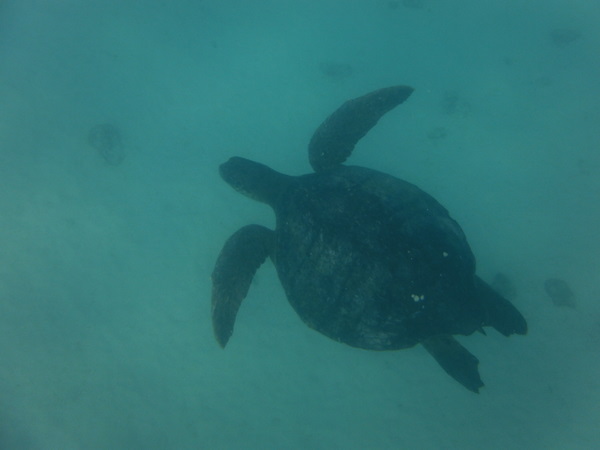
Turtles

White tipped reef sharks

Various rays

So many fish

We only visited the Southern islands on our cruise but I was pleased how much we did see. I think there will be a few returnees in years to come for further exploration! We flew back to Quito for one night before heading further South to Banos with one extra person on board. Rogan has joined us a crew as sadly Pete has to leave us in Lima, Peru to prepare and crew another upcoming trip. Rogan has driven for Odyssey many times before and seems like a nice guy so I'm sure we will still be in safe hands with him and Kirsten for the final sector of the trip back to Buenos Aires.

Galapogos, Ecuador part 1

Most of us arrived in Quito knowing one thing, that we were off to explore the Galapogos Islands. The Galapogos cruise had been booked since before we left the UK so 16 of us, very excited flew out the 3 hours to Baltra island to start our 4 night cruise.

The Galapogos Islands were made famous by Charles Darwin in 1831 when he visited the islands, looked at all the plants and animals and then wrote all his books on evolution. The islands are a UNESCO site and the Galapogos National Park protects 97% of the land with the other 3% being areas where people live.

We visited 6 islands and all were different in what they looked like and also what animal species they had living there as some species are endemic to certain islands. It was safe to say that from the moment we got to the dock to get on our boat, the very appropriately named 'Darwin' we had smiles plastered on our faces until the end of the trip as we were constantly treated to wildlife delights. Without even starting our cruise we had already seen sealions, pelicans and a swimming marine iguana!

The cruise had a busy schedule and I didn't actually realise how tiring it was going to be as we had many short walks planned and lots of snorkelling. If I'm honest, the underwater world beat the land world hands down and I could have happily had a week's worth of snorkelling. Saying that, the whole trip was great and worth every penny and the only thing I could fault was that there was far too much fish served on board. Yuk!

The wildlife was amazingly unfazed at our presence. There was a 2m distance rule applied but most things I'm sure you could have got closer to. The only thing that we saw from a big distance was the Galapogos Penguin. Even when on the boat we saw plenty as the birds followed us and one evening we had moored up so were able to watch nature's TV from the back of the boat which involved circling sharks, sealions and pelicans catching fish. Here's a list of a few things we saw and a fact if I can remember one:

Pelicans- can scoop up 2 gallons of water in a beak full and then filter the fish out.

Marine Iguanas- have adapted their tails to make them longer and flatter to aid swimming

Sally lightfoot crabs- unusually can walk sideways and forwards

Land Iguanas- we saw 2 species. One species had yellow feet and belly which it had got from eating lots of yellow flowers

Painted Locust

Lava lizards-males have the red throat.

Frigate birds- males have the red throat, females are brown and white colour

Sealions

Nazca booby

Blue footed booby- males do a dance for the females but ultimately the male with the bluest feet wins.

Lava Heron

Swallow tail gulls- the only bird to feed at night to avoid competition with frigate birds.

Mockingbirds-the male makes the nest as colourful as possible using bits of plastic collected from the ports. The female then picks the male with the most colourful nest. After eggs hatch the female leaves and then the male is left to look after the chicks.

Galapogos Hawk

Waved albatross

American Oyster catcher

Darwin finches

to be continued....

16 April 2013

Equator, Ecuador

It may be just a line around the centre of the Earth, but not in Ecuador where there is a monument and evidence of snow on the equator (so wrong). We stopped to take some photos on the road taking us from Otavalo to Quito

9 April 2013

Otavalo, Ecuador

We stopped in the town of Ipaires, 7km away from the Ecuador border for one night and crossed the next day. It was all very easy getting out of Colombia, no queues and a quick stamp. I changed the last of my pesos on the border which I wouldn't usually have done but it was a good rate. The guy nearly did me out of $10 by using a fixed calculator though. I'd done my research and had a list of how many dollars I should get at different rates so I quickly showed him what I should have been getting on a mobile phone so all was sorted. Ecuador was also a quick stamp and even the truck got through in record time. Sadly Keith and Karen were on the Ecuador system of being an overstay as they hadn't been entered into the computer when they had left Ecuador after a previous visit. Keith was cleared after 2 hours but Karen wasn't. We headed on to Otavalo but Karen, husband Steve and Kirsten had to go back to Colombia and go to the Ecuador embassy who couldn't do anything about it. After phone calls to the British consulate in Quito the Ecuador immigration people wouldn't budge resulting in Karen's old passport with the departure stamp having to be found at home and scanned to prove that she did leave the country 8 years ago!! I think we were all amazed to see them when they turned up that evening, only a couple of hours after us and has left everyone wondering where their old passports are!

We had a lovely walk around Otavalo today. Its central square is filled with tourist based craft market and the town was a great place to people watch. The older men and women walk around in traditional dress of long heavy skirts, ponchos, blankets/capes, lots of different hats, embroidered shirts and as a general rule they are the shortest people I have ever seen. Some of them couldn't have been taller than 4 foot 5!! Vanessa felt tall and Geoff felt like Gulliver! It was nice to have mooch around the stalls and I ended up buying a lovely winter coat from one of the shops. I think it's safe to say that we were spoilt for choice and that many souvenirs have been bought. I think the thing that's shocked people the most about Ecuador so far though is the fact that it's so cold. The warm weather gear is back out and it feels very wrong wearing it when we are practically on the equator! Next stop Quito and the Galapogos islands.

Popayan, Colombia

Popayan was a short trip from Salento and is a small whitewashed city. It was nice to have a wander around the day we got there but with a whole other day I needed something to do. 6 of us booked on a downhill mountain bike trip that would see us getting a lift up to some thermal springs and then biking back down 29km to the town. After seeing that the trip actually had a 3km uphill section, 3 bailed to do just the last 10km which was definitely downhill and myself, Anthony and Tony enjoyed a quick but sulphur smelling dip in the springs and then hopped on the bikes for the journey home. I had a great time as we had all road surfaces and weather and we also stopped for strawberries and cream and deep fried goodness on the way back.

I forgot to take photos so I'll have to wait till Tony's sent me some!

4 April 2013

Salento, Colombia

Leaving busy Medellin behind we headed further south to a coffee plantation near Menizales. Some people went on a coffee tour and did a tasting but I wasn't so interested as they didn't have the factory production bit on site. Instead I had a very relaxing day doing absolutely nothing.

We are currently in Salento a pretty small town but it's filled with some lovely food, a little shops. Last night we played Tejo which is Colombia's national sport. Basically you have an inclined soft clay board and in the centre is a metal ring with paper parcels of gunpowder placed on it. You then throw metals weights at the board and if you hit gunpowder parcels, bang!! Today some of us got jeeps out to the Valley of Cocora to do a walk. The scenery was amazing- very Jurassic Park like with 60m tall palm trees and the weather much cooler that it has been recently so all in all a very pleasant day out.